
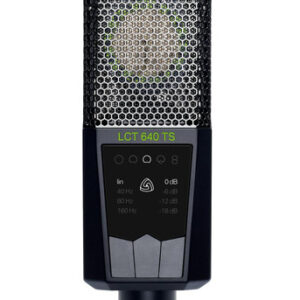
Description
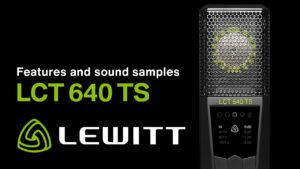
Here’s what Lewitt say about the LCT640 TS Microphone
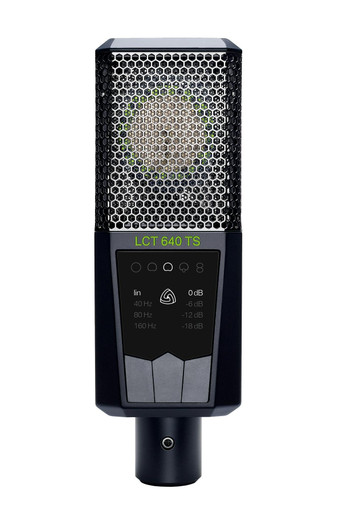
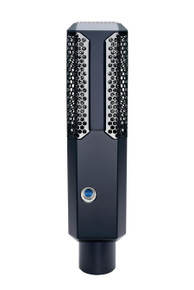
Designed and engineered in Austria, LEWITT’s new LCT 640 TS will revolutionize the way we think about the recording process. Set to Dual Output Mode the signal of the mics front and back diaphragm is provided by independent circuitries, any kind of polar pattern can be realized dynamically – even after the recording.
Already recorded material can be changed dynamically by adjusting the polar pattern – room sound can be added or decreased, even a turn by 180° is possible. After recording with the LCT 640 TS you can use LEWITT’s Polarizer plugin to tweak the material with incredible ease of use.
In Multi-Pattern Mode the LCT 640 TS has all the well-known characteristics of a great sounding studio multi-pattern condenser mic. It features five polar patterns: omni, wide cardioid, cardioid, supercardioid and figure-8. Perfect Match technology takes care that all LCT 640 TS are having the exact same sensitivity at 1 kHz. The Dual Output Mode allows to record in stereo with only one LCT 640 TS – usually only possible with two microphones. Clipping History, 4 low-cut and pre-attenuation settings round off the outstanding feature list of the LCT 640 TS. The LCT 640 TS opens doors to a new world of recording techniques.
Specifications
- Type: Condenser, permanently polarized
- Acoustical operating principle: Pressure gradient transducer
- Diaphragm: 3 micron gold sputtered Mylar
- Transducer Ø: 25.4 mm, 1 in
- Polar pattern (Dual Output Mode) : Create any polar pattern in post-production
- Polar pattern (Multi-Pattern Mode) : omni, wide cardioid, cardioid, supercardioid, figure-8
- Sensitivity: 31.4 mV/Pa, -30.1 dBV/Pa (cardioid), 30.3 mV/Pa, -30.3 dBV/Pa (omni), 34.1 mV/Pa, -29.4 dBV/Pa (figure-8)
- Equivalent noise level: 10.5 dB (A), cardioid
- Max. SPL for 0.5 % THD : 133.8 dBSPL, 0 dB pre-attenuation
- Signal/ Noise Ratio: 83.5 dB (A)
- Pre-attenuation pad – 0 db, -6 dB, -12 dB, -18 dB
- Low-cut filter- ear, 40 Hz (12 dB/oct), 80 Hz (12 dB/oct), 160 Hz (6 dB/oct)
- Dynamic range: 123.3 dB (A)
- Internal impedance: 110 Ω
- Rated load impedance: 1.000 Ω
- Supply voltage: 48 V +/- 4 V
- Current consumption: 5.1 mA
- Connector: Gold plated 3-pin XLR + Mini 3-pin XLR
- Microphone dimensions: 158 x 52 x 36 mm, 6.22 x 2.04 x 1.42 in
- Microphone net weight: 425 g, 14.9 oz