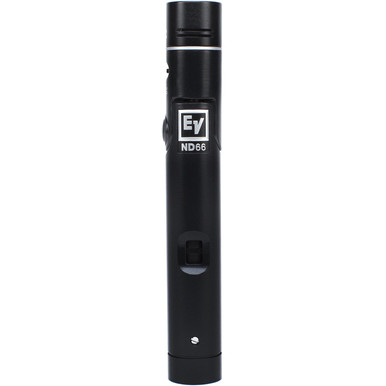
Electro-Voice ND66 Cardioid Condenser Instrument Microphone

£162.00

Electro-Voice ND66 Cardioid Condenser Instrument Microphone is New by Electro-Voice . Get it superfast with our delivery roadie service to any door in the UK Read More for product details.

More Details


Description

The Electro-Voice ND66 Cardioid Condenser Instrument Microphone is New Delivered to all areas of the UK using our roadie delivery service.

Here's What Electro-Voice Have To Say About the ND66:

The ND66 is a robust, high-performance small-diaphragm condenser instrument microphone. Its self-biased small-diaphragm condenser element is vividly responsive to the complex dynamic nature of percussive and stringed  instruments,  and delivers a clean, crisp and detailed sound. With the ND66’s exclusive locking rotating  head , achieve ideal mic placement in virtually any situation by merely pushing a button, rotating the head into position, then releasing the button to lock the head's position.

Features:

  • Premium small-diaphragm condenser element – Self-biased condenser element is vividly responsive to sound sources that need a mic which translates transient details very well
  • Clean, crisp and detailed condenser sound – Captures all details of percussive and stringed instruments
  • Easy mic placement with locking pivoting head – Achieve ideal mic placement in virtually any situation by pushing a button, pivoting the head into position and releasing the button to lock
  • Selectable -10 and -20 dB pads – Provides the necessary gain reduction to prevent the mic element from overloading
  • Selectable 75 Hz and 150 Hz high-pass filters – Selectable HPF frequencies are strategically chosen to eliminate bothersome low frequencies from the signal path

In the Box 

  • Electro-Voice ND66
  • Mic Clip
  • Windshield 
  • Storage Pouch

Specifications 

  • Connector Type: 3-pin XLR
  • Audio Frequency Response: 50 – 20,000
  • Maximum SPL: 146dB
  • Polar Pattern: Cardioid
  • Wired/Wireless: Wired
  • Mic Type: Instrument
  • Element: Condenser
  • Impedance, Low-Z balanced: 200Ω
  • Open Circuit Voltage: 10mV/Pascal
  • Case Material: Die cast zinc
  • Finish: Black polyurethane paint
  • Power Requirement: 48 VDC Phantom

Additional information

Weight 0.5 lbs

Information about Electro-Voice

No description available yet.

Information about Condenser Microphones

Condenser microphones are widely used in studio recording because of their sensitivity, clarity, and ability to capture fine detail. They are commonly chosen for vocals, acoustic instruments, piano, strings, and room recording, where accuracy and nuance matter. Condenser microphones usually require phantom power and are available in large and small diaphragm designs, making them suitable for everything from intimate vocal takes to detailed overhead and ambient recordings.

Information about Microphones

Microphones are essential tools for capturing sound in recording, broadcast, and live performance. Different microphone types are designed for different sources, environments, and uses, from studio vocals and instruments to live sound and field recording. Choosing the right microphone depends on factors such as sound source, room acoustics, sensitivity, and the character you want to capture.

Information about Cardioid

Cardioid is a directional microphone pickup pattern that captures sound primarily from the front while reducing sound from the sides and rear. It is widely used for vocals, podcasting, and live sound, helping to control background noise and reduce feedback in both studio and performance environments.

Information about Condenser

Condenser microphones are highly sensitive microphones designed to capture detail, clarity, and nuance. They are widely used in studio recording for vocals, acoustic instruments, piano, and ambient sound. Condenser microphones typically require phantom power and are available in large and small diaphragm designs, making them versatile tools for accurate sound capture.

Information about Instrument

Instrument microphones are designed to capture the sound of musical instruments accurately and reliably. They are commonly used on guitar amplifiers, drums, brass, strings, and acoustic instruments, with designs suited to handling high sound levels while preserving clarity and detail.

Available for Amazon Prime